Melissani Cave: myth, finds and geology
Going without a car?Every tour here picks you up in Argostoli and cancels free up to 24 hours before. Reserve the date now, decide later.
Check tour availabilityThe nymph
Melissanthi loved Pan, Pan did not love her back, and she threw herself into the lake; the cave has been the Cave of the Nymphs ever since. A quieter variant has a shepherdess who lost her footing and fell in. Either way the story picked the right god, because when the islet in the middle of the open chamber was dug it turned out to be his.
The lamp, the dig and the museum that is shut
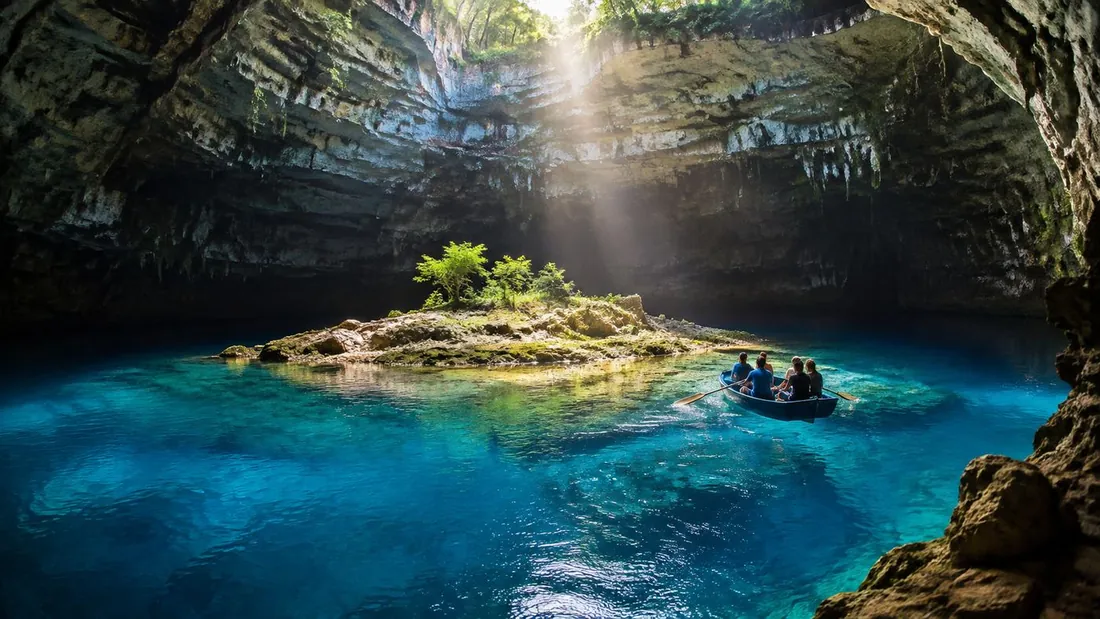
In 1951 the Greek speleologist Ioannis Petrocheilos explored the cave and found an ancient oil lamp on the islet, about 30 m long, that sits in the open chamber. In 1962 the archaeologist Spyridon Marinatos excavated the islet and identified a sanctuary of Pan and the Nymphs: a clay figurine of Pan, a clay disc of dancing nymphs, lamps and plates, dated to the fourth and third centuries BC. The lamp is the clue to the cult: people came down to the water, in the dark, with lights.
The finds belong to the Archaeological Museum of Argostoli, which has been closed since the 2014 earthquake; the building was demolished and a replacement is under construction with no reopening date. So the sanctuary is a thing you see from the boat, as the islet the boatman rows round, and not a thing you see in a case. In 1963 the 70 m entrance tunnel was cut and the cave opened to the public. Where the boat goes, and what you pass.
The roof fell in long before anyone wrote it down. The lake underneath had already crossed the island to get here.
The geology, from the Geopark
Melissani is geosite 25 of the Kefalonia–Ithaca UNESCO Global Geopark, and the Geopark’s description is the one this page follows. It is a submerged doline, a karst cave in Upper Cretaceous limestone whose roof collapsed: two chambers joined by a narrow passage, the first open to the sky, the second closed and hung with stalactites, with the islet in between and the second chamber continuing as a siphon about 240 m long. The accessible cave is about 160 m long and the main lake about 60 by 40 m. The drop from the ground surface to the water is about 20 m, the total vertical relief about 36 m, and the water is up to thirty-odd metres deep. The stalactites in the closed chamber have been dated at 16,400 to 20,400 years old; the limestone is far older, and no date is put on the cave itself.
The roof fell in long before anyone wrote it down; the 1953 earthquake is credited with the final collapse that exposed the lake as it is seen today, which is the Geopark’s reading and a different one from the “thousands of years ago” on most travel sites. The hole is the size of a tennis court or more; the published dimensions disagree, so no figure is printed here.
Water from the other side of the island
The lake is brackish and it should not be there at all. Its surface is about 1 m above sea level and 500 m from the sea, and the water is sea water that sank into the Katavothres, the sinkholes on the coast at Argostoli on the west side of the island, crossed underneath Kefalonia and came back up here on the east coast, mixed with fresh water from inland. The same water surfaces at Karavomylos lake by the shore, about 1 km from Sami harbour, and from there finally reaches the sea. The proportions of salt and fresh are given differently by different sources and are left out.
The link was proven in 1963 by two Austrian hydrogeologists, Viktor Maurin and Josef Zötl, working with Petrocheilos: they tipped uranine dye into the Katavothres at Argostoli and it surfaced at Melissani and Karavomylos roughly two weeks later. The dye went in on the side of the island where the tours start and came out where they end, which is a fair description of the day. Karavomylos lake and the other cave.
The nine-hour island day is the tour with a guide telling the island’s story all day, between the monastery, the winery and the two caves. One August 2026 reviewer: “Her history stories and everything she said kept us all wanting to hear more, huge recommendations for her.” (Dubravka). That is why it is the tour on this page.
Seeing it
None of this needs a museum. The islet, the two chambers, the rope passage and the stalactites are the ten minutes of the boat ride, and the brackish water is what you are floating on; the ticket is about ten euros and includes the boat. Tickets and prices. For the island around the cave, the nine-hour tour visits the Monastery of Agios Gerasimos and a Robola winery before both caves, and Fiscardo after, with an English-speaking guide all day. It is rated 4.8 and leaves the cave tickets to be paid on site.
Book the full island day with a guide
Nine hours with hotel pickup: monastery, winery, Drogarati, Melissani, Fiscardo, the Myrtos viewpoint and a tasting. Cave fees paid on arrival. Free cancellation up to 24 hours before.
Read next
Frequently asked questions
Why is Melissani called the Cave of the Nymphs?
For the nymph Melissanthi, who in the story drowned herself in the lake for love of Pan, and for the sanctuary of Pan and the Nymphs that Spyridon Marinatos identified on the islet in 1962, with finds of the fourth to third century BC. The islet is what the boat rows round.
Who discovered Melissani Cave?
The Greek speleologist Ioannis Petrocheilos explored it in 1951 and found an ancient oil lamp on the islet. The entrance tunnel was cut and the cave opened to the public in 1963. The tunnel, and the steps in it.
Why is the water in Melissani salty?
Because most of it is sea water that sank into the Katavothres sinkholes at Argostoli, crossed under the island and surfaced here, mixed with fresh water. Viktor Maurin and Josef Zötl proved it with dye in 1963, which took roughly two weeks to cross. That is also why you cannot swim in it: it is a protected Geopark site, deep and cold.
How deep is Melissani Lake?
Up to thirty-odd metres, with the water about 20 m below the ground surface. The accessible cave is about 160 m long and the main lake about 60 by 40 m. Some sites print a length in kilometres; that is wrong.